Learn
Security hardening reduces the Windows attack surface at the kernel level , closing the exploitation pathways that attackers use to neutralize endpoint defenses.
Security hardening is the process of reducing a system's attack surface by making it more resistant to exploitation. For Windows endpoints, this means reinforcing the kernel architecture, restricting dangerous privilege escalation paths, and protecting security software from being tampered with or disabled.
Modern endpoint threats frequently target the Windows kernel, the most privileged layer of the operating system. Attackers who achieve kernel‑mode execution can disable any security software, manipulate system behavior invisibly, and remain completely undetected for extended periods.
Effective hardening prevents these paths from being viable, regardless of which specific vulnerability or technique is used.
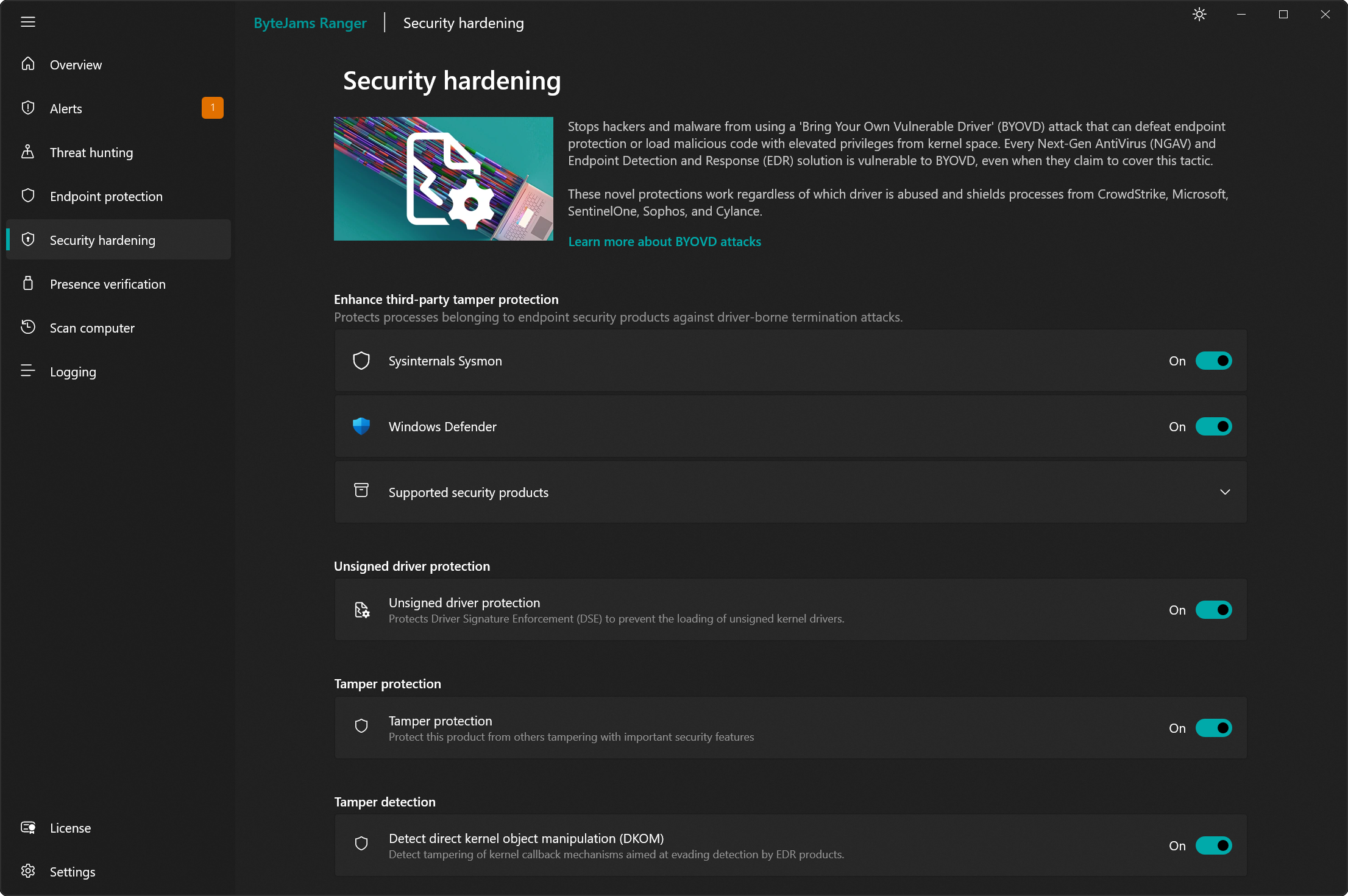
Attackers load legitimate but vulnerable signed drivers to gain kernel‑mode code execution without bypassing driver signing requirements. Once in the kernel, they terminate EDR processes, remove kernel callbacks, and operate freely. See BYOVD for a detailed explanation of this technique.
Even without BYOVD, attackers may attempt to tamper with EDR kernel components directly, removing kernel callbacks, patching agent memory, or exploiting race conditions in security software. Strengthening the kernel architecture around these components makes tampering significantly harder.
Vulnerabilities in the Windows kernel itself or in system services can allow attackers to escalate from user‑mode to kernel‑mode. Reducing exposed kernel interfaces limits the available escalation surface.
Ranger's security hardening does not depend on identifying specific vulnerable drivers or attack signatures. Instead, it restructures the kernel‑level environment to close the exploitation pathways that BYOVD and tamper attacks rely on, providing protection against both known and unknown techniques.
This approach complements existing security solutions rather than replacing them. Ranger strengthens the foundation that CrowdStrike, Microsoft Defender, SentinelOne, and others build on.
Ranger's tamper protection enhancement works alongside existing endpoint security deployments , strengthening their kernel‑level defenses without requiring replacement or reconfiguration.