Learn
Bring Your Own Vulnerable Driver is one of the most powerful techniques attackers use to neutralize endpoint defenses, and blocklists alone cannot stop it.
BYOVD stands for Bring Your Own Vulnerable Driver. It is an attack technique in which a threat actor deliberately loads a legitimately‑signed but known‑vulnerable Windows kernel driver onto a target system, then exploits its vulnerability to execute arbitrary code in kernel mode.
Windows requires all kernel‑mode drivers to be digitally signed by Microsoft. Attackers cannot easily create and sign malicious drivers themselves because the signing process involves vetting. Instead, they abuse signed drivers from legitimate products: graphics cards, audio hardware, antivirus software, disk utilities, and monitoring tools.
These drivers are legitimate, trusted, and signed, but they contain vulnerabilities that allow privileged kernel operations to be triggered from user mode.
The attacker first establishes a foothold on the target machine, typically through phishing, stolen credentials, or exploitation of an internet‑facing service.
A legitimate but vulnerable signed driver is written to disk and loaded into the Windows kernel using standard driver installation mechanisms. Because the driver is signed, Windows loads it without complaint.
The attacker triggers the vulnerability in the loaded driver from user mode, gaining the ability to execute arbitrary code with kernel‑level privileges.
With kernel access, the attacker terminates EDR/AV processes, removes their kernel callbacks, disables security logging, or patches security agent memory, rendering all endpoint protection blind.
With defenses neutralized, the attacker deploys ransomware, exfiltration tools, or persistent backdoors without any security tool raising an alert.
Microsoft maintains a vulnerable driver blocklist, but it is reactive. New vulnerabilities are discovered continuously, and attackers actively seek out less‑known vulnerable drivers that are not yet on any blocklist.
BYOVD has been used by advanced threat groups including Lazarus Group (North Korea), BlackByte ransomware, and RobbinHood ransomware to silently neutralize endpoint defenses before deploying their payloads.
The fundamental problem is that blocklist‑based approaches are always one step behind: a vulnerable driver must be identified, reported, and added to the list before protection kicks in. During that window, which can span months, attackers operate freely.
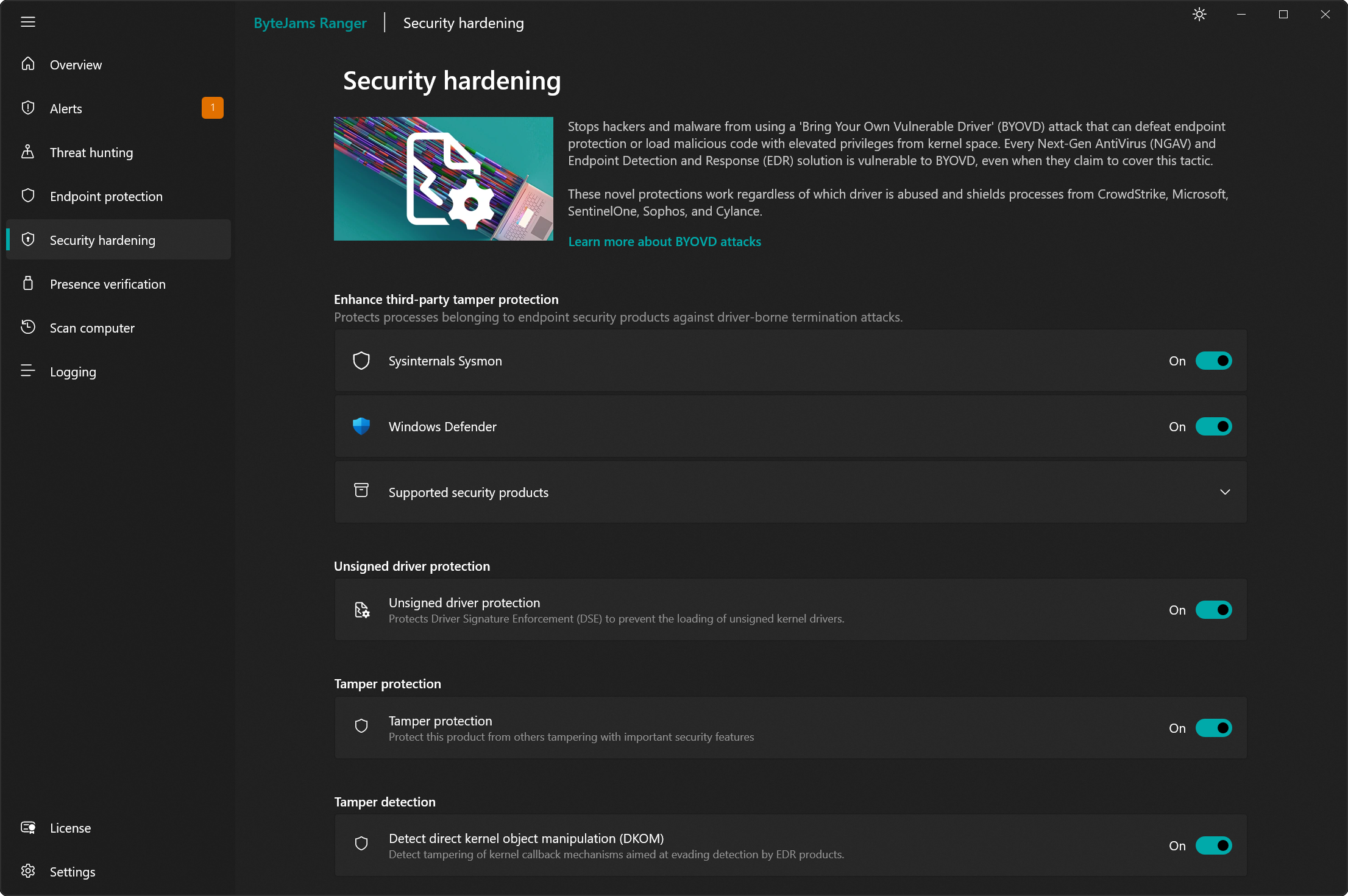
Rather than maintaining a list of known‑bad drivers, Ranger hardens the Windows kernel architecture itself , closing the exploitation pathways that BYOVD attacks depend on, regardless of which specific driver is used.
This approach provides protection against both known and unknown vulnerable drivers, including zero‑day BYOVD techniques that have never been publicly disclosed.